The catalog, shelf by shelf, read by the effort of putting things on
Each shelf below gathers garments that usually close in similar ways. Read the shelf, note what decides the effort there, then open it in the catalog.
All 16 Spreadsheet categories
Each image links to the corresponding catalog category. Start with these buying checks, then use the specialist notes below. Listing details and agent restrictions must be confirmed for your own order.
 SneakersCompare the length and width, not only a size label.
 OuterwearCheck lining, closures and garment measurements.
 HoodiesRead the chest and length measurements.
 T-shirtsCompare the selected print, fit and fabric description.
 JeansMeasure waist, rise and inseam against a pair you own.
 SweatpantsCheck waistband range and leg measurements.
 WomenswearUse the item measurements; sizing varies by seller.
 JerseysConfirm the exact version, size and print options.
 BagsCheck dimensions, included straps and closures.
 HatsCheck crown size, adjustment and construction.
 BeltsCompare usable length, width and buckle fit.
 EyewearRead frame dimensions; a photo does not prove UV protection.
 PerfumeConfirm purchase and shipping eligibility before payment.
 JewelleryCheck material claims, measurements and included pieces.
 WatchesVerify the model and shipping restrictions, including batteries.
 ElectronicsConfirm the exact model, input rating and permitted route.
Why the shelves are read in this order
The Spreadsheet below follows the same eight shelves as the home page, from the garments that usually ask least of you to the ones that usually ask most. The order is not a ranking of quality. A pair of jeans can be the right choice for someone whose hands are steady and whose balance is not; the order only tells you where the fastenings tend to pile up.
Under each shelf you will find what usually makes a garment easy or hard to put on there, what to look for in the listing photos, and a link to that shelf in the catalog. Each catalog link goes to the shelf itself, so you can scroll the actual finds with the checklist beside you.
The catalog changes daily. We do not pick or recommend individual listings, and we do not name brands: everything here is about the shape of the garment.
Pull-on trousers and joggers
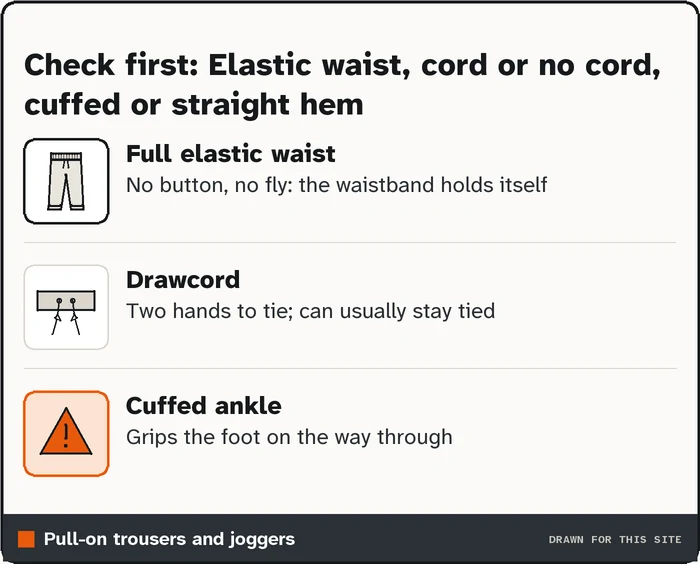
A full elastic waist removes a button or fly, but the wearer still needs to stretch the opening over the hips and position the garment. Check whether a drawcord must be tied to hold it up. A familiar pair with a comparable waistband is a more useful reference than an “easy-on” label.
Cuffed ankles are the other detail to look at. A tight ribbed cuff grips the foot on the way through, so threading each leg takes longer, especially seated. Straight or wide hems slide over the foot.
Open the shelf: Pull-on trousers in the catalog. Look for: elastic waist, cord or no cord, cuffed or straight hem.
Coats and jackets
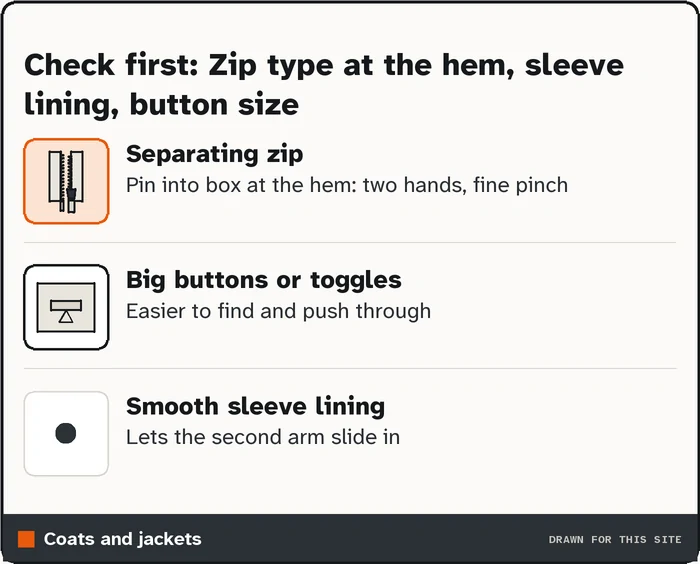
Almost every coat opens down the front, so the lift over your head is not the issue here. The issue is the second sleeve, which sits behind your back once the first arm is in, and the fastening at the bottom of the zip. Nearly all jacket zips are separating zips: the pin on one side has to be pushed into the box on the other before the slider will move, which takes two hands and a fine pinch.
A smooth lining in the sleeves helps the second arm slide in. Toggles, big buttons and snaps are the alternatives to a separating zip. Heavy coats add weight on the shoulders while you reach for that second sleeve.
Open the shelf: Coats and jackets in the catalog. Look for: zip type at the hem, sleeve lining, button size.
Hoodies and sweatshirts
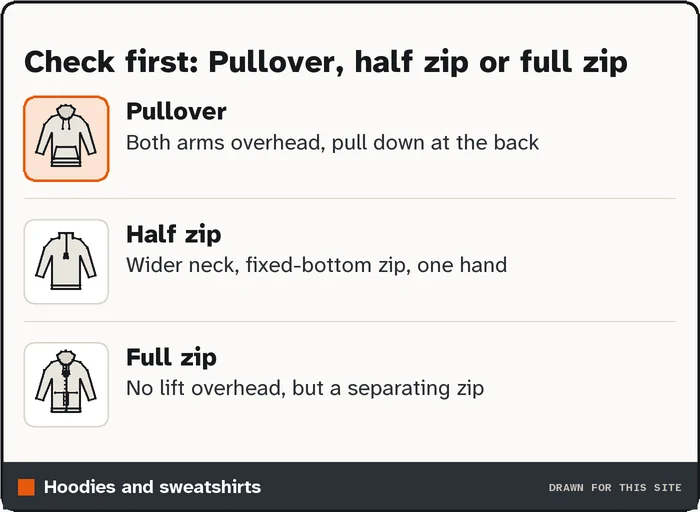
This shelf holds the clearest choice on the site: the same garment as a pullover or with a zip down the front. The pullover asks for both arms overhead and a pull down at the back. The zip-front version removes the overhead lift but brings back the separating zip at the hem.
Half-zip sweatshirts sit between the two: the neck opens wider so the head goes through more easily, and the short zip has a fixed bottom, so it works one-handed.
Open the shelf: Hoodies in the catalog. Look for: pullover, half zip or full zip.
Dresses and skirts
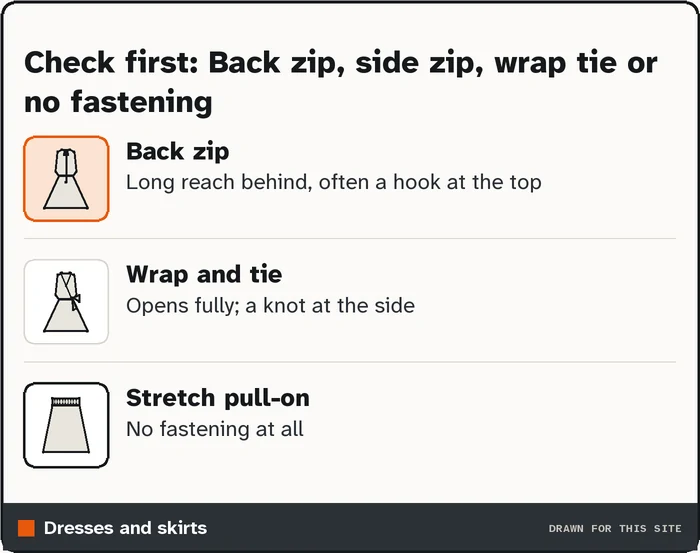
Dresses split three ways. Stretch knit dresses with no fastening pull on over the head or step in from the floor. Dresses with a zip down the back need a long reach behind, often to a hook at the top as well. Wrap dresses open fully and tie at the side, which removes the reach but adds a knot.
Skirts are easier as a group: most pull on, and the waistband is the main thing to check. A side zip is easier to reach than a back zip. This shelf is a catalog search rather than a fixed category, so expect a mix of garments in the results.
Open the shelf: Dresses and skirts in the catalog. Look for: back zip, side zip, wrap tie or no fastening.
Tees and knit tops
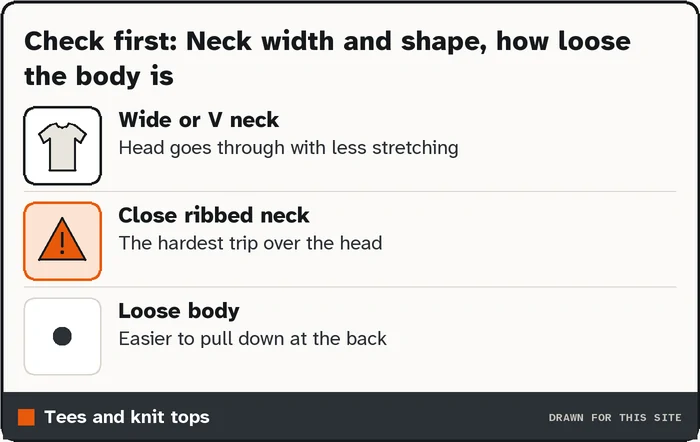
Every tee goes over the head. What changes is how far: a wide crew neck, a scoop or a V neck lets the head through with less stretching, and a loose body is easier to pull down at the back. Tight ribbed necks are the hardest. Knitted, stretchy fabric gives more than a stiff woven one.
If both arms overhead is the hard move, this shelf is rarely the answer. Look at knitwear for cardigans instead.
Open the shelf: Tees in the catalog. Look for: neck width and shape, how loose the body is.
Knitwear and cardigans
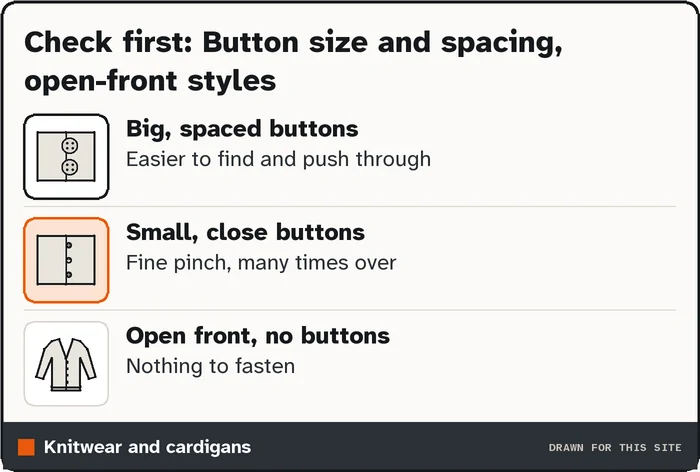
Cardigans are the classic front-opening top, and knit stretches, which helps the second sleeve. The buttons are what to check: bigger buttons with a little space between them are easier to find and push through than small ones set close together. Some cardigans have no buttons and simply hang open.
Pullover sweaters on the same shelf behave like heavy tees, with the extra weight of the knit to lift.
Open the shelf: Knitwear in the catalog. Look for: button size and spacing, open-front styles.
Jeans
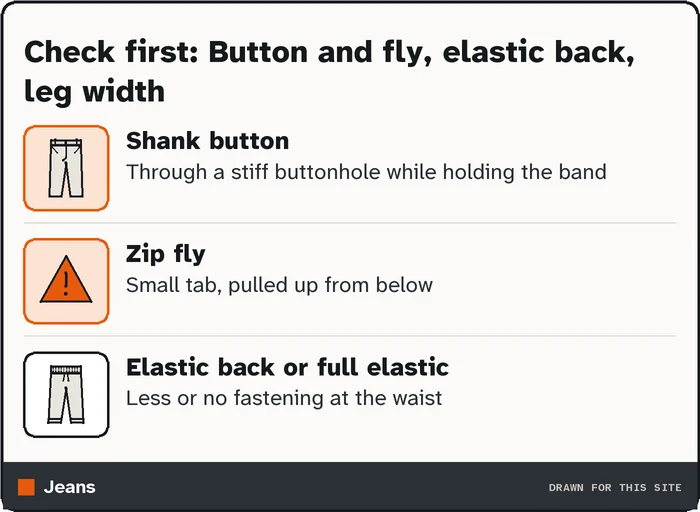
Jeans ask for the most pinching of any trouser. A metal shank button goes through a stiff buttonhole, then the zip fly is pulled up from a small tab. Denim does not stretch much, so the waistband has to be held while the button goes in. Some listings offer a partly elastic back waistband, and pull-on denim with a fully elastic waist exists too.
Threading the legs while standing is the balance problem; wide legs make it shorter.
Open the shelf: Jeans in the catalog. Look for: button and fly, elastic back, leg width.
Shoes
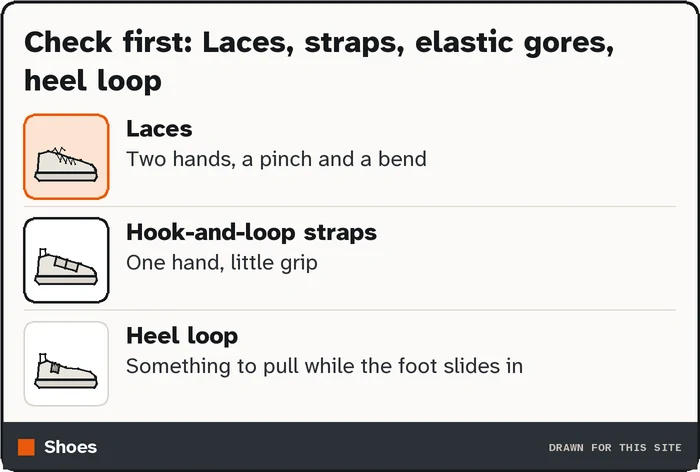
Shoes combine bending, balance and fastening. Laces need two hands, a pinch and a bend. Hook-and-loop straps need one hand and very little grip. Elastic gores and slip-on shapes need no fastening at all, and a loop at the heel gives a finger something to pull.
The catch, explained on the shoes page, is that foot-health leaflets prefer shoes that fasten firmly to ones held on by the toes.
Open the shelf: Shoes in the catalog. Look for: laces, straps, elastic gores, heel loop.
Hats, bags and the smaller shelves
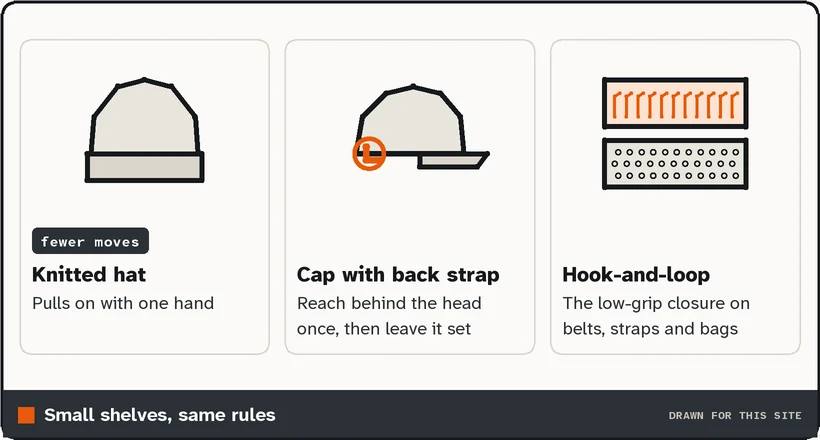
Hats are quick: a knitted hat pulls on with one hand and needs no fastening. Caps with an adjustable strap at the back need a reach behind the head and a pinch on the buckle or snap tabs, though most people set them once and leave them. Hats that tie under the chin need two hands. Hats in the catalog.
Bags matter for dressing only in one way: a cross-body strap goes over the head like a pullover, and a backpack needs one arm behind the back for the second strap. Clasps, buckles and small zip pulls follow the same rules as on garments. Bags and belts have their own shelves.
Belts deserve a note: a buckle with a prong needs a pinch and a steady hand; a plain elastic belt or one closed with hook-and-loop does not. Watches, glasses, jewelry and electronics have their own shelves in the catalog and are outside what this site covers.