
Single-handed dressing: the order that works and the garments that suit it
When one hand is doing the work of two, the order you dress in and the closures you choose decide almost everything.
One free hand, and the garments that suit it
Dressing with one hand is more common than it sounds. An arm in a sling after a fall, a wrist that will not grip in the morning, a hand that is weaker than the other, or simply a baby on one hip: each leaves one hand doing work meant for two. The garments that suit this are the ones whose closures never need two hands at the same moment.
Elastic waists, pull-on tops with a wide neck, closed-bottom zips, magnets, hook-and-loop and large snaps all pass that test. Separating zips, small buttons, cuff buttons, bows and back hooks usually fail it. Front-opening tops can go either way: easy to get into, hard to close if the closure is small.
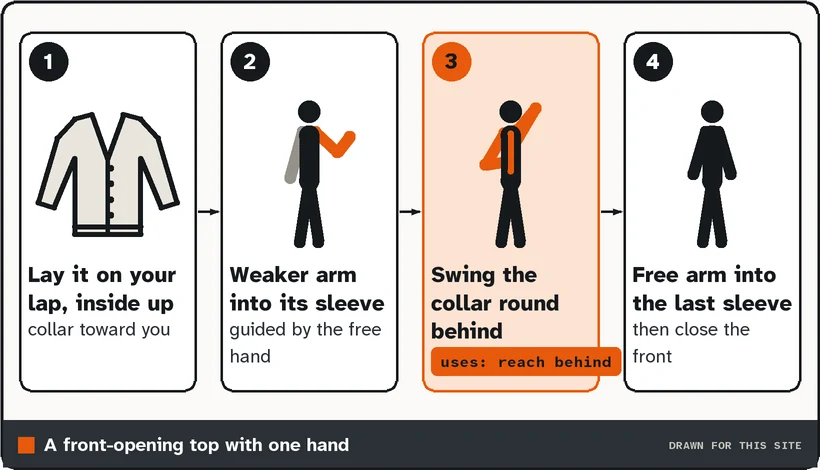
The side that moves less goes in first
Published dressing leaflets describe techniques for particular situations, including putting an affected arm into a garment first. Those examples are not universal instructions for every injury or person. Follow the wearer’s own clinician or occupational therapist if movement is restricted; use this page to identify the garment openings and fasteners that need checking.
The reason is practical. While the stronger arm is still free, it can guide the garment over the arm that moves less. Do it the other way round and the stronger arm is trapped in a sleeve just when it is needed. The NHS Wales guide adds that if both arms have some movement, both should still take part, even if one only holds something in place.
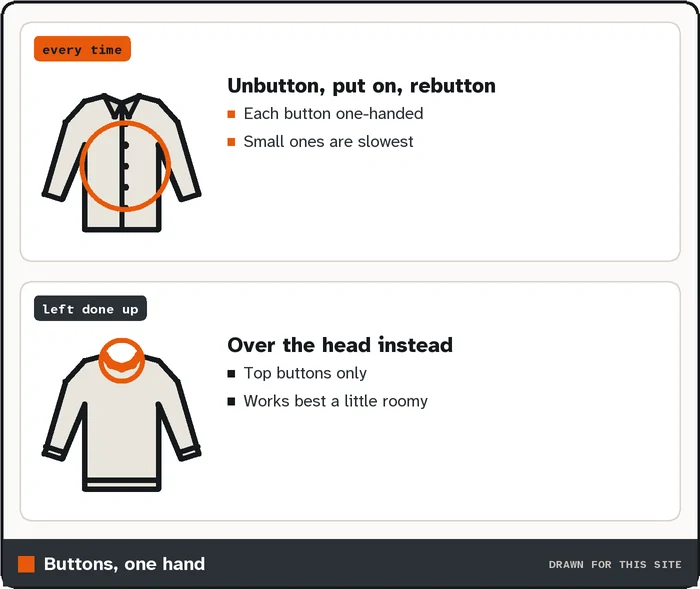
Buttons with one hand, and the pullover way round
Buttoning with one hand is possible and many people learn it, but it is slow, and small buttons make it slower. Two workarounds come up again and again in the guidance. The first is not to unbutton fully: St. Jude suggests buttoning all but the top few and slipping the garment on and off over the head. The second is choosing the shirt a little roomier, so it can stay buttoned and go on like a pullover, as the Worcester guide suggests.
Button hooks, small tools that pull a button through the hole, are mentioned in the St Vincent's and St. Jude handouts; occupational therapists can show how they work. For catalog shopping, the useful takeaway is simpler: large buttons, few of them, set in a placket that does not need holding flat.
Zips with one hand
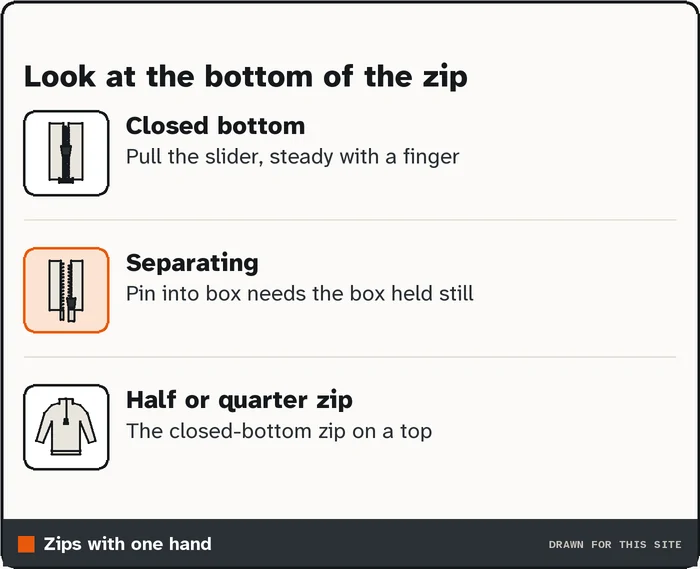
A closed-bottom zip works one-handed: hold nothing, or pin the garment against your body with the forearm, and pull the slider. The NHS Wales guide suggests steadying the zip with a finger while the same hand works it up. A separating zip does not work one-handed for most people, because the pin has to go into the box while the box is held still. That puts most zip jackets and zip hoodies out of reach without help.
The way round it on the catalog shelves is the half-zip or quarter-zip top, a zip-front garment with a closed bottom, or a jacket that closes with snaps or magnets. For a jacket you already have, people often leave the zip engaged at the bottom and step into it or take it over the head, which only works on roomy jackets.
Trousers and skirts with one hand
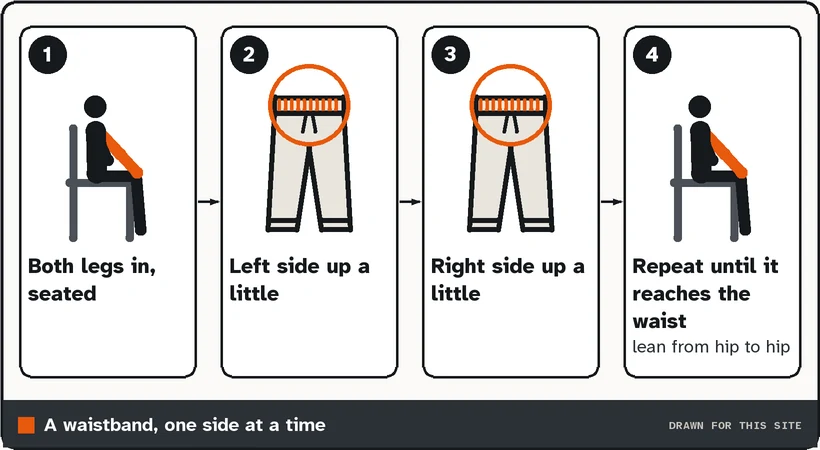
With one hand, elastic waists are close to essential. The NHS Wales guide describes working trousers and pants up or down by alternating between sides until the waistband is in place, a method that works seated and needs only one hand at a time. Pull-on skirts work the same way. Buttons and flies at the waist are the hard part; a hook-and-bar is no easier for most one-handed dressers.
Socks and shoes follow: the same guide mentions socks with a large opening and tube socks without a heel as easier, and the shoes page covers hook-and-loop straps and elastic laces.
What one hand rarely manages
Being honest about the hard cases saves wasted orders. With one hand, most people find these slow or impossible without help or a tool: tying a bow in laces or a waist tie, hooks at the back of a top or dress, cuff buttons on the free arm, a separating zip, a buckle with a prong, and tights. One-handed shoelace techniques exist and some people learn them, as the St. Jude guide notes; elastic laces or straps avoid the question.
None of this means the garment is wrong for everyone. It means that if one hand is what you have, the catalog has a version without that step on nearly every shelf, and it is worth finding.