Fastenings: what your fingers have to do to close a garment
Buttons, zips, snaps and magnets ask for different mixes of aim, pinch and strength. Knowing which one a garment uses tells you most of what dressing in it will cost.
Small buttons and the fastenings that replace them
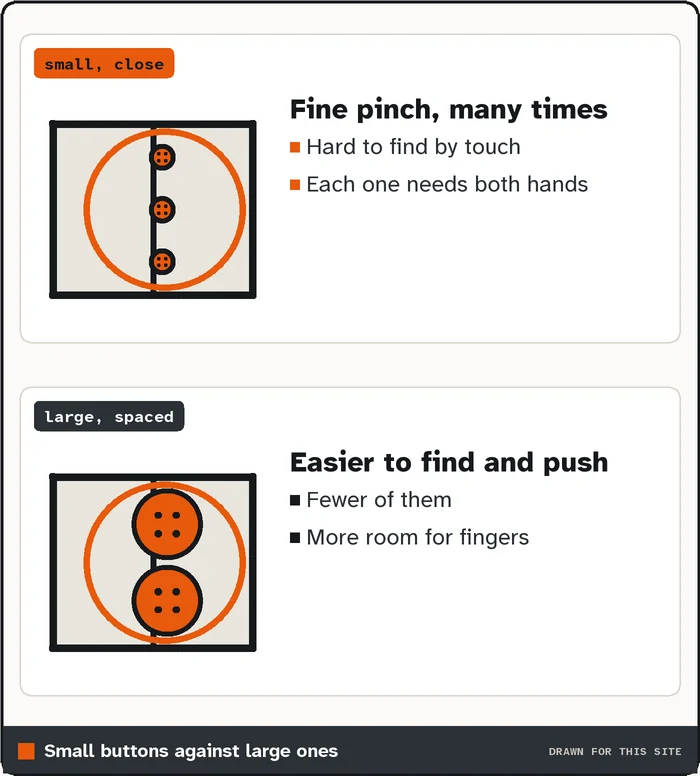
A button asks for a lot from a pair of hands. You hold the fabric with the buttonhole in one hand, find the button by touch or sight with the other, tilt it edge-first into the slit and push it through while pulling the fabric over it. Small buttons, slippery buttons, stiff buttonholes and buttons set close together all make it harder.
The guidance is consistent here. The University of Worcester carer guide (read 19 October 2026) says larger buttons and chunky zips are often easier for people who find fine finger movements difficult, and Living made easy lists hook-and-loop, press studs, zips, magnetic and button-through closures as alternatives that may be easier than standard ones.
So when this site says a fastening "replaces" small buttons, it means a design you choose instead in the catalog: a cardigan with big, well-spaced buttons, a jacket that snaps shut, a shirt that closes with magnets behind ordinary-looking buttons. It does not mean altering a garment you already own.
Snaps, hook-and-loop, toggles and magnets side by side
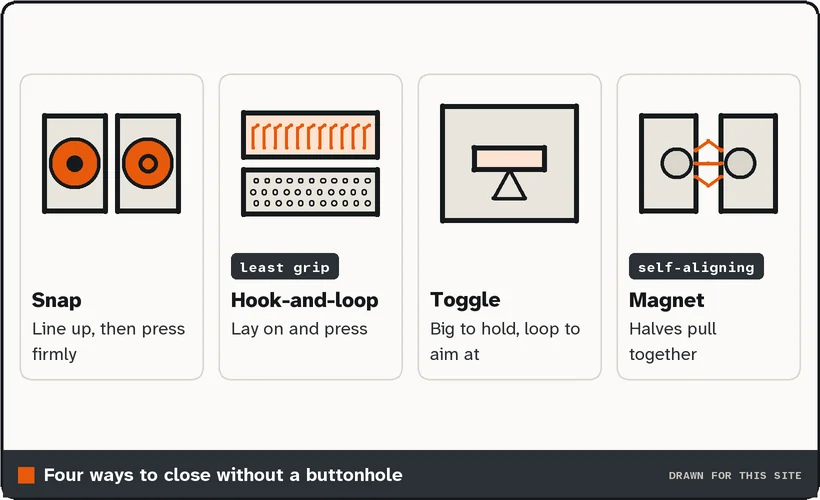
Different fasteners require different movements. A snap needs alignment and pressure; hook-and-loop needs the strips brought together and enough force to separate them; a toggle needs a loop positioned over it. Size, stiffness and wear all matter. The name of the fastener alone cannot establish how easy it is for the wearer.
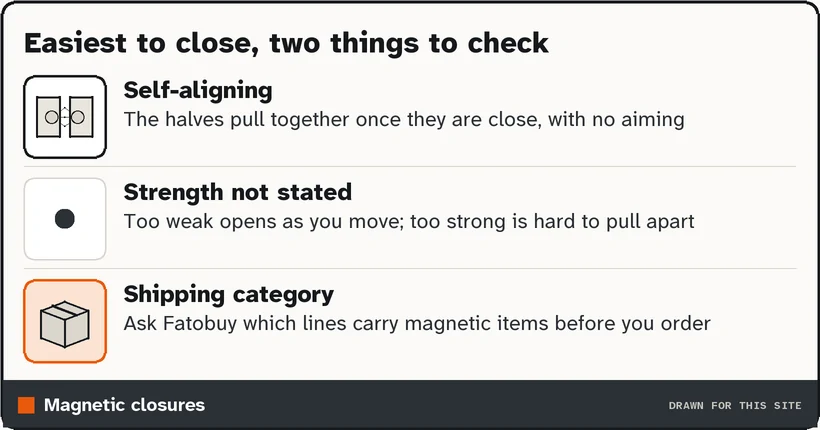
A toggle is a large bar pushed through a loop: easy to hold, but the loop has to be aimed at. Magnets do the aiming for you; the two halves pull themselves together once they are close. That makes them the lowest-effort closure on this list, with two catches covered in the magnet section below.
Zips that need two hands, and zips that need one
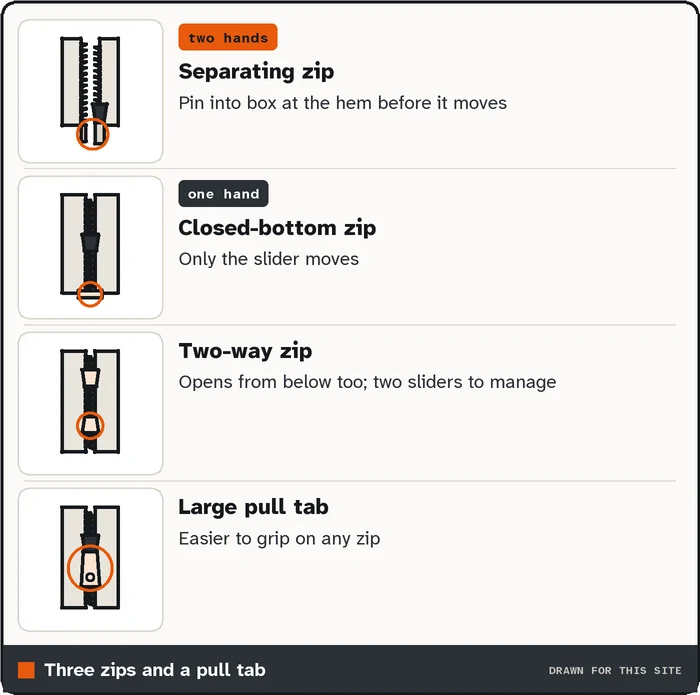
Zips come in three kinds that matter here. A separating zip, the kind on almost every jacket and zip hoodie, comes apart completely at the bottom. To close it you hold the slider and its box steady with one hand and push the pin on the other side into the box with the other, then pull. It is a two-handed job with a fine pinch, done at the hem where you may not see it well.
A closed-bottom zip, as on a half-zip top, trousers or a back-zip dress, never comes apart. You only pull the slider. A two-way zip has a second slider at the bottom, which lets a long coat open from below for sitting, but adds a second part to line up.
Whatever the type, the pull tab is the part your fingers meet. A long, wide tab, or one with a ring or loop, is easier to grip than a small flat one; it is worth checking in the listing photos before ordering.
Magnets on a garment, and the shipping question they raise
Magnetic closures are often hidden: a shirt that looks buttoned may close with magnets hidden behind the buttons, and some jackets use magnets along the front edge or at the collar. Living made easy lists a shirt of exactly that kind. They close themselves once the two halves are near each other, which suits shaky or stiff hands and one-handed dressing.
Ask for a paid closure check only after naming the visible or mechanical question it is meant to answer. Get the scope and current charge first: opening a zip for a photograph is different from assessing the effort needed by its intended wearer. That distinction matters more than an old conversion estimate.
Ask in writing and keep the answer. If the answer is no line, a snap or hook-and-loop version is the practical alternative.
Cuffs, collars and the fastenings people forget
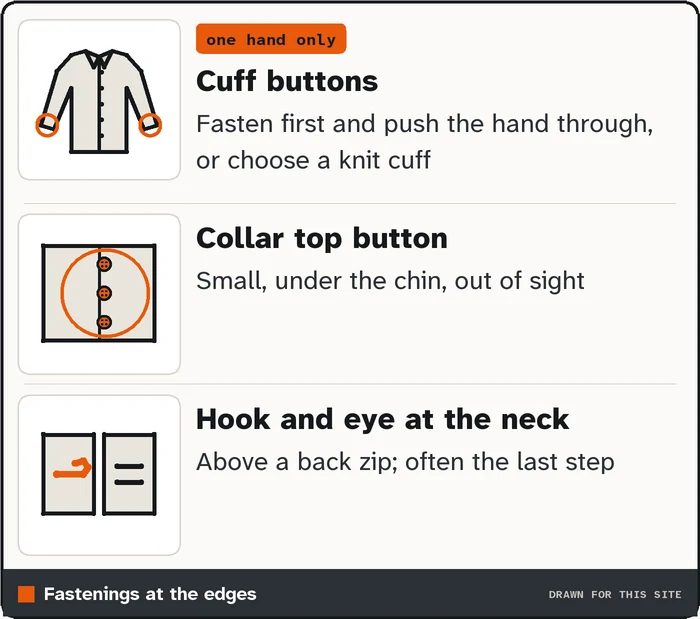
A shirt can have a manageable front and still stop you at the wrists. Cuff buttons are small and have to be done up one-handed by definition, since the other hand is inside the cuff. If the cuff is wide enough, the usual workaround is to fasten it before putting the shirt on and push the hand through; a looser, barrel cuff or a knit cuff with no button removes the problem.
The Worcester carer guide adds a related trick for whole shirts: a slightly bigger shirt, left buttoned, can be pulled on and off over the head like a pullover. Top buttons at the collar, a small hook and eye above a back zip, and press studs at the neck of a jacket are the other small fastenings that rarely appear in a listing's main photo but decide whether you can finish dressing alone.
Finding a fastening by feel and by sight
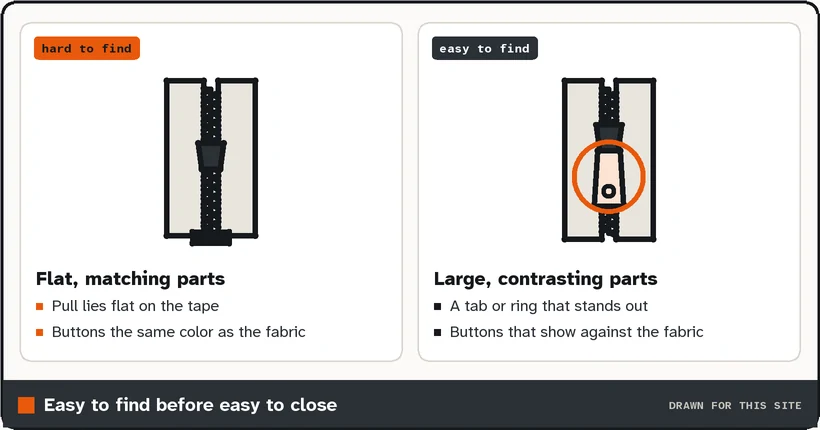
Effort is not only strength and grip. A dark button on dark fabric is harder to find than a light one, and a zip pull that lies flat against the garment is harder to catch than one that stands out. Garments with contrasting buttons, a pull tab in a different color or a ring on the slider can be easier to manage, especially in poor light or for anyone with reduced vision.
In the catalog these details are usually visible only in close-up photos further down a listing. The listing page covers where to find them, and the checks page covers asking Fatobuy's warehouse for a close-up when the seller did not take one.