Field notes
Fatobuy Spreadsheet: the detailed reading room
The original specialist explanations and interactive tools, collected in one place. Start with the buying guide for the full order journey.
Dressing sequence: pick a garment, mark the hard moves
Choose one garment, then tick any move that costs you effort or that you would rather skip. The steps it usually takes to put that garment on appear in order; the ones that use a ticked move turn orange, and underneath you get the designs that usually take that step away, where a seller's photos tend to show them, and how far Fatobuy's warehouse photos and paid checks can confirm them. Nothing you tick leaves this page: no account, no cookie, no address bar change.
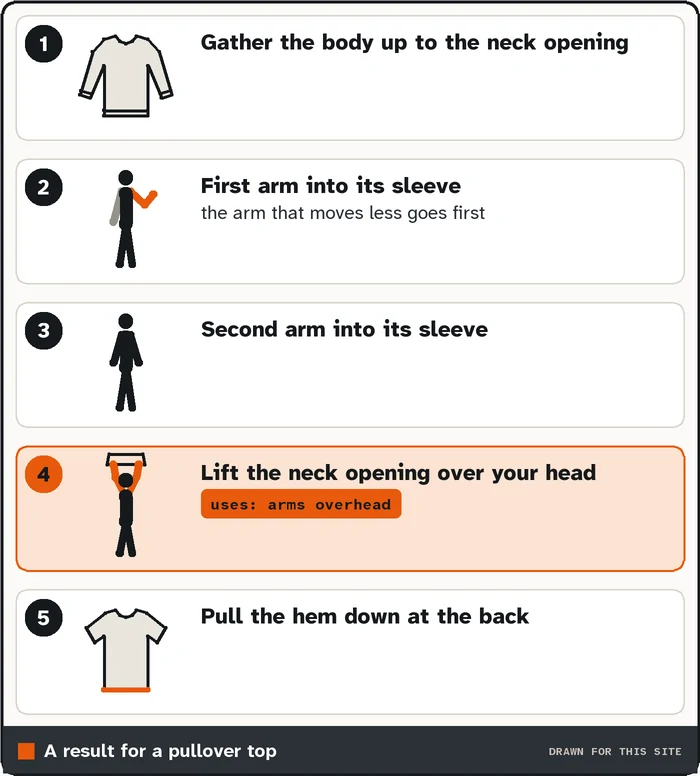
Pullover top
Tick a move to see which steps use it.
- Gather the body up to the neck opening
- First arm into its sleeve
- Second arm into its sleeve
- Lift the neck opening over your head
- Pull the hem down at the back
What a Fatobuy Spreadsheet means on this site
A Spreadsheet, in the sense used across these pages, is a product catalog: shelves of finds from Chinese shopping platforms, grouped by type, each card linking to the original listing. You pick something there and paste its link into a shopping agent, which buys it for you, checks it at a warehouse and posts it abroad. Fatobuy is a shopping agent of that kind. So what is a Fatobuy Spreadsheet? A catalog of finds read with Fatobuy as the agent in mind.
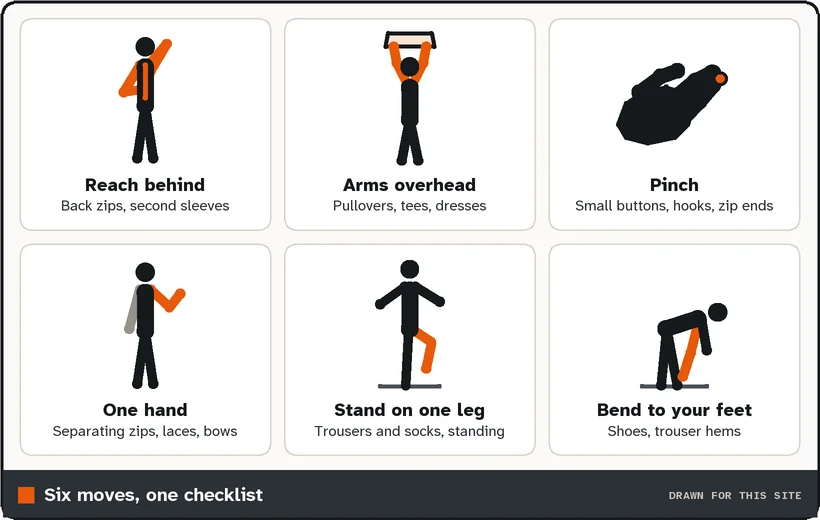
Most catalogs sort by price, popularity or style. This one adds a question they skip: how much does this garment ask of the person putting it on? A pullover needs both arms overhead. A dress with a zip down the back needs a long reach behind. Jeans need a button pinched through a stiff buttonhole, and lace-up shoes need a bend to the floor and two hands for the bow.
We are not Fatobuy and Fatobuy does not run this site. We do not sell anything or hold stock. Where we quote Fatobuy, we link the help page and give the date we read it. Where we describe how garments usually behave, the advice comes from public guidance written by health services and occupational therapists, plus common practice with ordinary clothes, and we say which is which.
The six moves a garment can ask for
Every garment on these pages is read against the same six moves. They come from the questions carers and occupational therapists ask before helping someone dress: can the arms go up, forward and back; can the person stand from sitting, and for how long; can they stand on one leg. We added the two that decide most fastenings: pinching something small, and doing it with one hand.
None of these is a medical label, and none of them needs one. Plenty of people find one move hard for a week after a sprain, or every morning before the stiffness wears off, or permanently. A parent dressing a wriggling toddler while holding a bag is down to one free hand too. If a move costs you effort, tick it in the tool and read the shelves with it in mind.
How to use the tool, and what it keeps to itself
Start with the garment you are actually shopping for, not the one you find hardest; the tool is there to compare like with like. Tick the moves that cost you effort and read the orange steps first. Then look at the designs listed underneath: each one usually removes or shortens a marked step. A front-opening cardigan removes the lift over your head; an elastic waist removes the button and the fly.
When a design looks right, search the catalog for it using the words in the result, open a few listings and check the photos for the feature. If the photos leave it out, the result tells you what Fatobuy can photograph or check once the item reaches its warehouse, and what no photo can tell you.
Everything the tool does happens inside your browser. It does not ask for a name, an age or a reason, it does not store your ticks and it does not put them in the page address, so a shared link never carries them. Reloading the page clears everything.
Where each page goes deeper
The tool gives a short answer. The topic pages give the reasons and the trade-offs, with the sources.
- Openings: pullovers against front openings, neck openings, half zips, side openings and the reach behind your back.
- Fastenings: button size, snaps, hook-and-loop, toggles, magnets, and which zips need two hands.
- Waistbands: full elastic, drawcords, fly fronts, hook-and-bar, and how skirts and dresses close.
- Dressing seated: trousers with a higher back, pockets you can reach from a chair, and helping someone else dress.
- One free hand: dressing order, buttons, zips and trousers when only one hand is doing the work.
- Shoes: step-in styles, heel loops, straps, elastic laces, boot zips, and why foot-health leaflets are wary of slip-ons.
Two more pages connect the catalog to the order: reading a listing for the opening and fastening before you pay, and what Fatobuy checks once the item reaches the warehouse.
Where Fatobuy comes in between the catalog and your door
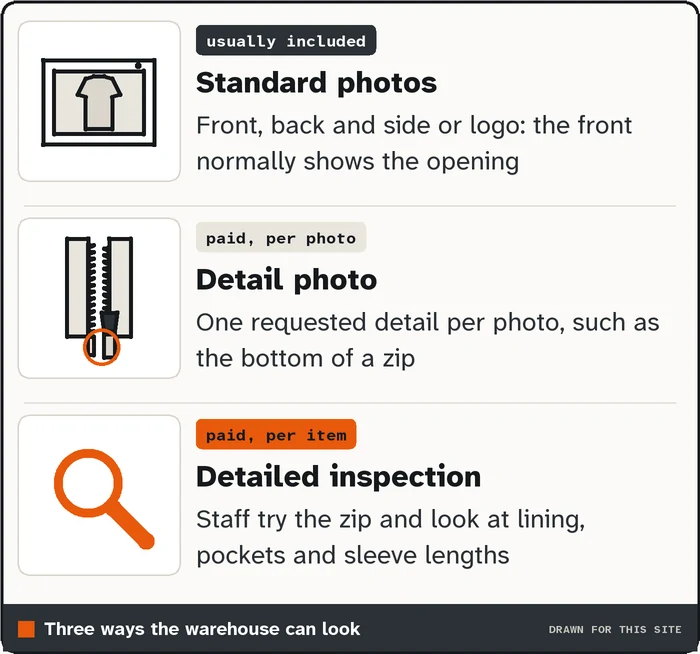
Fatobuy buys the item from the seller and holds it at its warehouse in Jinjiang, Fujian, before you ship it. That pause is useful here. The warehouse usually takes three standard photos of each item, and the front one normally shows whether a top opens down the middle or goes over the head.
For a fee you can ask for more: a close-up of one detail per photo, or a detailed inspection in which staff try the zip to see that it is "intact and usable". Neither tells you whether you will find the zip easy; that judgement stays with you. The checks page sets out exactly what each service covers, and the Fatobuy page covers fees, storage, shipping and after-sales.
Fatobuy itself: fatobuy.com (the link carries a tag naming this site and no invite code).