
Reading a listing for its opening and fastening before you pay
A listing usually tells you how a garment opens and closes, if you know which photo to look at and which words to trust.
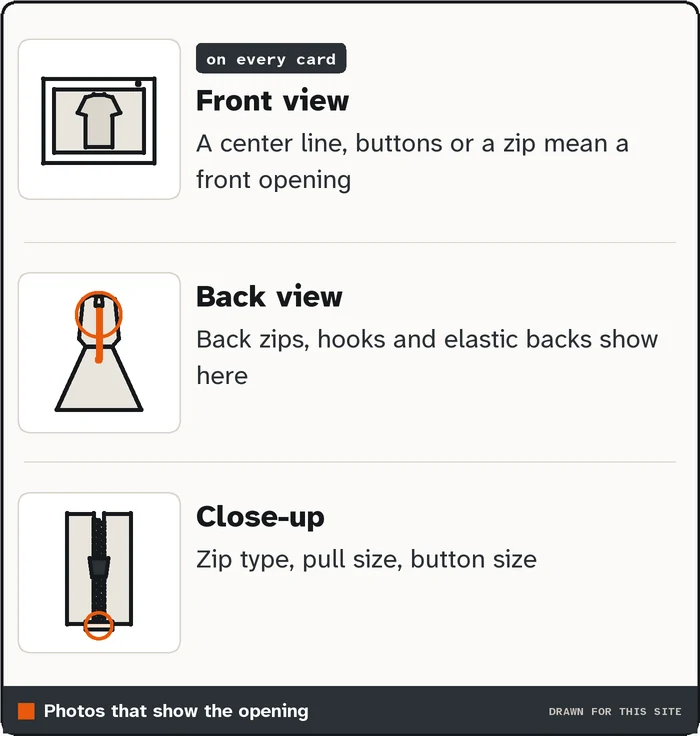
Reading an opening from the seller's photos
Catalog cards show one photo, usually the front of the garment. That photo already answers the first question on this site: does the top open down the middle or not? A line of buttons, a zip running the full length, or two front edges that overlap all mean a front opening. A plain, unbroken front means a pullover, unless the opening is at the back.
So open the listing and look for a back view. Sellers on Chinese platforms usually post several photos, and the back view, when there is one, is where back zips, back hooks and elastic-back waistbands show. Flat-lay photos, with the garment laid on a surface, show openings and pocket positions more clearly than photos of a model, whose pose and arms often hide the front edge. Photos on a hanger sit in between.
If the only photos are posed shots on a model, count the opening as unknown until you have checked it another way.
Words in a listing that point to an easier garment
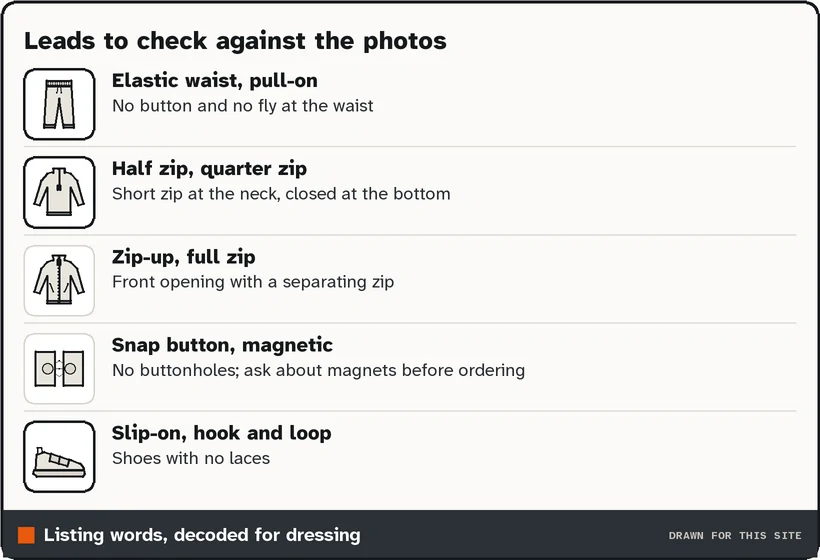
Listing titles on the catalog are translated from Chinese and vary a lot, but a handful of phrases turn up often and mean roughly the same thing each time. "Elastic waist" or "pull-on" means a waistband with no button or fly. "Zip-up", "full zip" or "zip front" means a front opening with a separating zip; "half zip" or "quarter zip" means a short closed-bottom zip at the neck. "Open front" on knitwear means no buttons at all.
"Snap button" or "press stud" means snaps, not buttonholes. "Magnetic" means magnets, with the shipping question from the fastenings page. "Slip-on" on a shoe means no laces; "hook and loop", often written with a trade name, means straps. "Wrap" means a garment that opens fully and ties or buttons at the side.
Read every one of these as a lead, not a promise: check the photos for the feature before you order. A title can describe the shelf the seller wanted to appear on rather than the garment you will receive.
Detail photos: zip ends, buttons, the inside of the waistband
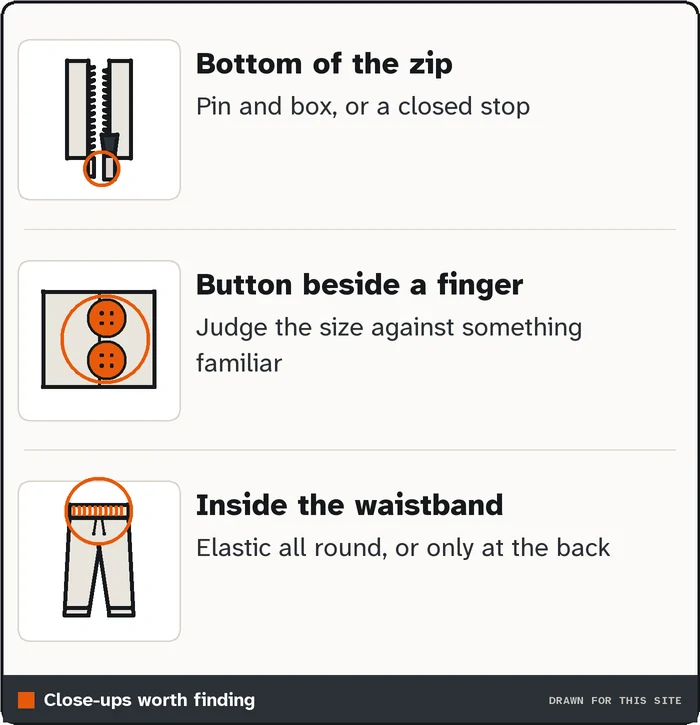
Further down most listings sit the detail photos: close-ups the seller took of the fabric, the label, the pockets and, often, the closure. These are where the questions on this site get answered. Look for the bottom of the zip, to tell a separating zip from a closed one. Look at a button next to something familiar, such as a finger or a coin, to judge its size. Look at the inside of the waistband, to see whether the elastic runs all the way round or only at the back.
Some listings include a short video. A few seconds of someone zipping or buttoning the garment tells you more about stiffness than any still photo can.
If you cannot find these details anywhere in the listing, note what is missing. It becomes your request to the seller, or to Fatobuy's warehouse later.
Asking the seller before you order
Sellers on Chinese platforms answer questions in a chat window, but you are ordering through Fatobuy, so the practical route is the note you attach to the order. Fatobuy's buyers read it when they buy; a short, specific question in that note can be passed to the seller. Ask one thing at a time: is the zip closed at the bottom, is the waistband elastic all the way round, are the buttons real or covering snaps.
How to judge a seller from this distance: a seller whose listing has detail photos of the closure, clear option names and consistent photos across colors has usually thought about what buyers need to see. A listing that mixes photos of visibly different garments, or uses only borrowed model shots, gives you less to go on.
Keep questions factual. "Is it easy to put on" has no useful answer; "is the zip closed at the bottom" does.
When the photos leave the fastening out
Sometimes the listing simply does not show the part you care about. You have three choices. Pick a different listing for the same kind of garment where the photos do show it; the catalog usually has several. Ask in the order note and wait for the answer. Or order it and ask Fatobuy's warehouse to photograph that detail when the item arrives, before you decide whether to ship it.
The third route costs a little and takes a day, and it has a limit: by the time the warehouse photographs the item, you have already paid for it. If the photo shows the wrong closure, sending it back to the seller depends on the seller agreeing, within a short window. That makes the first two routes worth trying first.
A last look at the listing before paying
Deciding what to buy comes down to a short check before you press pay. Does the option you selected match the photo that shows the closure? Listings often group several versions under one link, and the zip-front and pullover versions can share a page. Is the closure you want visible in at least one photo, or confirmed in writing? Have you noted in the order what to photograph if it is not?
Watch out for two common traps. Option names translated as "style A" and "style B" can hide different closures, so match each option to its photo. And a garment shown open on a model may close with something you cannot see; look for the closure itself, not just the opening.