
Shoes: getting a foot in without a long bend or a bow
Footwear asks for a bend, a moment of balance and a fastening, often all at once. The right shoe takes at least one of those away without loosening its hold on your foot.
Shoes you can step into
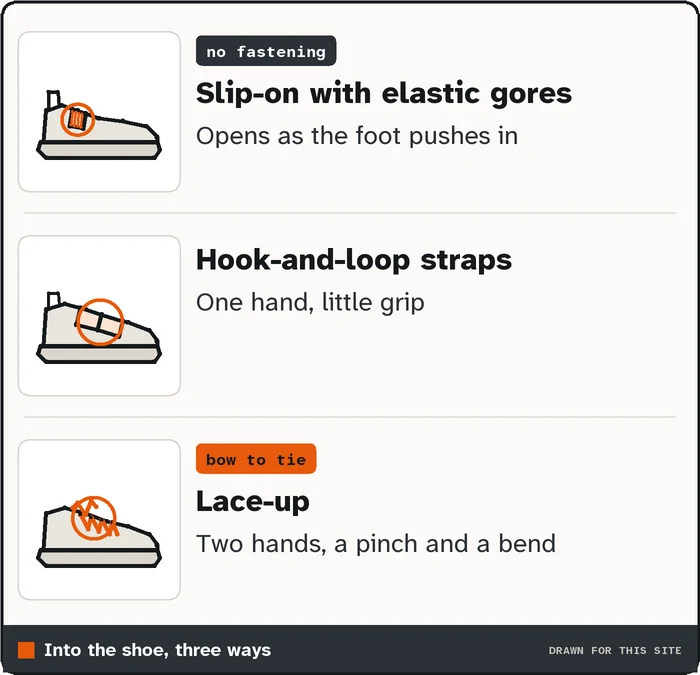
Shoes ask for three moves at once: a bend or a lifted foot to reach them, balance while the foot goes in, and fingers for the fastening. A shoe you can step into removes the last of these and shortens the other two. Slip-on shapes with an elastic panel at the sides, called gores, open as the foot pushes in and close behind it.
St. Jude (read 19 October 2026) lists slip-on shoes and hook-and-loop fasteners for children dressing with weak hands, and the falls leaflet Steady on your feet (read 19 October 2026) from Kent Community Health NHS Foundation Trust names hook-and-loop among good shoe fastenings. Both point at a shoe that goes on without a bow.
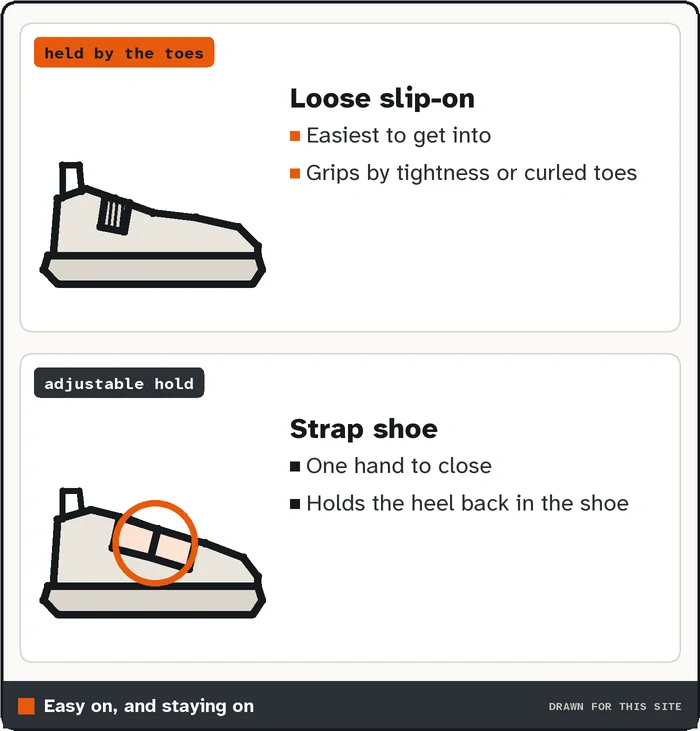
There is a condition attached: the shoe has to stay on once it is on. The section on staying on your feet, further down, explains why foot-health leaflets are wary of slip-ons that rely on a tight grip.
Heel loops, pull tabs and wide openings
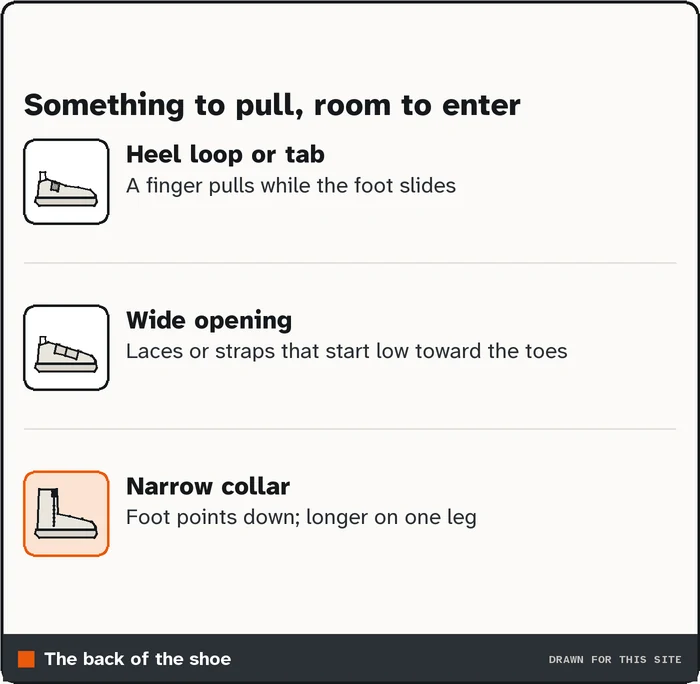
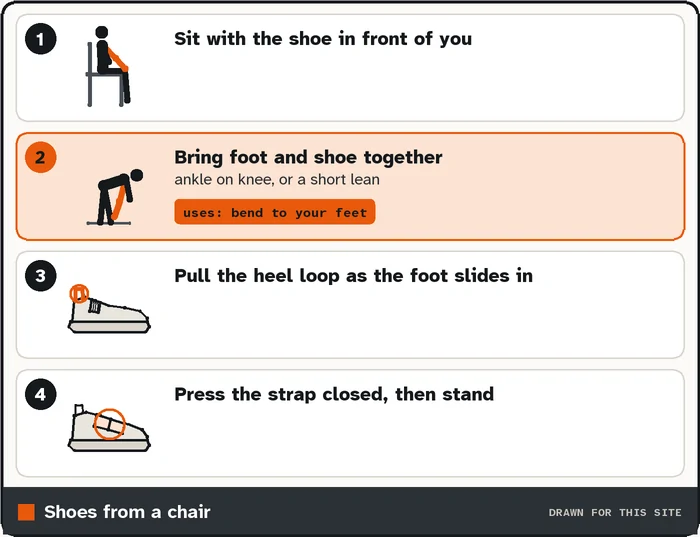
A loop of tape at the back of the heel, or a tab sticking up from it, gives a finger something to pull while the foot slides in. It turns a two-handed squeeze of the heel counter into a one-finger tug. Many sneakers and boots have one; listings rarely mention it, but the side or back photo shows it.
The opening itself matters as much. A shoe whose upper opens wide, with laces or straps that run far down toward the toes, lets the foot in at a shallow angle. A narrow collar makes the foot point down into the shoe, which needs more ankle movement and more time on one leg.
A long-handled shoehorn, a common dressing aid, does the heel loop's job from standing height; it is worth knowing about if bending is the hard move.
Hook-and-loop straps, elastic laces and ordinary laces
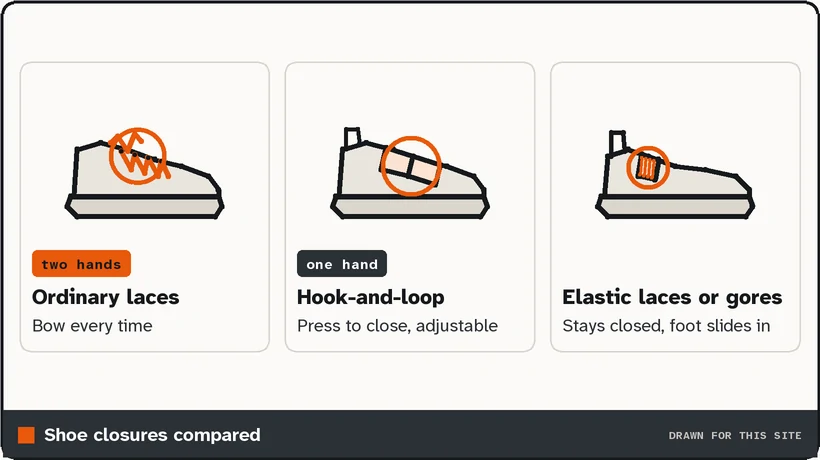
Ordinary laces are the most demanding closure on the shoe shelf: two hands, a fine pinch, a bow, and a bend to the floor or a foot lifted to the hands. Hook-and-loop straps cut that to a single press with one hand, and they can be tightened or loosened to hold the foot. Elastic laces stay tied: the shoe becomes a slip-on that still holds the foot. St. Jude mentions both for children who find laces hard.
Buckles sit in between: a single strap with a buckle needs a pinch on the prong but no bow. For many people the best compromise on this shelf is the strap shoe, for the reason in the next sections.
Back zips and side zips on boots
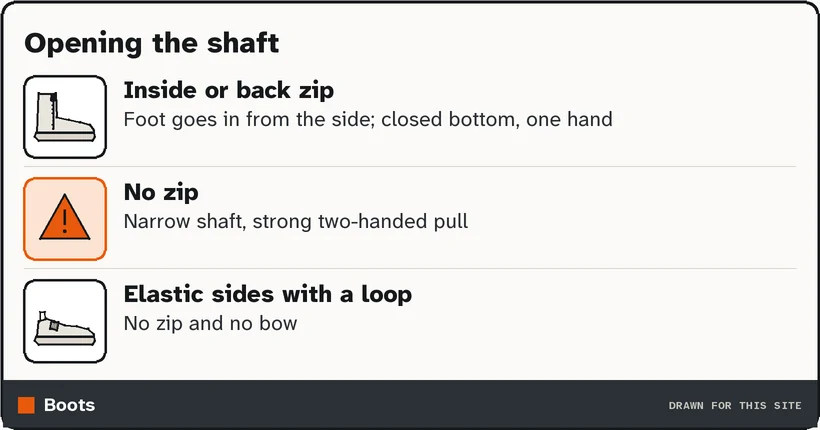
Boots without a zip are the hardest footwear to get on: the foot has to travel down a narrow shaft, which takes a strong pull with both hands and a lot of ankle movement. A zip on the inner side or the back opens the shaft so the foot goes in from the side. The zip is closed at the bottom, so it works with one hand, but it sits low, which brings back the bend.
A large pull tab or a loop on the zip slider helps here more than anywhere, because you are reaching for it at ankle height. Chelsea-style boots with elastic sides and a pull loop at the back avoid the zip and the bow together.
Slip-ons and staying on your feet
Here the easy option and the safe option pull apart. NHS foot-health leaflets ask for shoes held firmly on the foot by an adjustable fastening. The Torbay and South Devon NHS Foundation Trust (read 19 October 2026) podiatry leaflet describes a poor shoe as a slip-on or court shoe kept on by curling the toes, and asks for laces, straps with buckles or hook-and-loop. The East London NHS Foundation Trust (read 19 October 2026) leaflet says slip-ons have to be tight to stay on, which can damage the toes, even in wider versions. Kent Community Health's falls leaflet lists laces, hook-and-loop or a buckle as good.
A fastening that is easy to manage still needs to hold the shoe appropriately. Check the opening, adjustable range and fit; hook-and-loop does not guarantee secure support for every foot. For advice about balance, foot problems or prescribed footwear, use the wearer’s qualified clinician rather than a product photo.
Bending to your feet, and doing it seated
Bending from standing to reach your feet combines the two moves this site marks as balance and bend. Sitting removes the first. From a chair, most people either cross one ankle over the other knee to bring the foot closer, or lean forward with the foot flat on the floor; the first needs hip movement, the second a longer bend.
The shoe can shorten the bend further: a heel loop you can reach with a shoehorn or a finger, a strap you close by pressing down from above, a wide opening the foot can find on its own. Put shoes on last, seated, after trousers, and stand only once they are fastened.